Fighting between Ngāi Te Rangi and supporters, and British troops in Tauranga was a battle of belief as well as of arms.
Henare Taratoa's challenge to Colonel Greer of 28 March was followed by a letter setting down a code of conduct by which Ngāi Te Rangi would take up arms. Taratoa's stance was one inspired by his strong Christian conviction, a faith shared by many in the Tauranga district by 1864. To defend his people, and independence, was not to forsake a faith in God.
Bible reading and Christian services had been part of life around the Tauranga harbour since the 1830s. Maori who travelled to the Bay of Islands brought knowledge of 'the book' to the region. From early in 1838 Alfred and Charlotte Brown set up home on the Te Papa peninsula in order to spread the Christian gospel as Church Missionary Society teachers. Charlotte Brown died in 1855. By 1864 61-year old Rev Alfred Brown had lived 26 years in Tauranga where he was known by, and knew, most people. The mission station was a common calling-in place for travellers around the harbour and around the coast.
When British troops arrived in Tauranga in late January 1864 they occupied land and buildings at the mission station. This was later to become a matter of dispute between the church and the government.
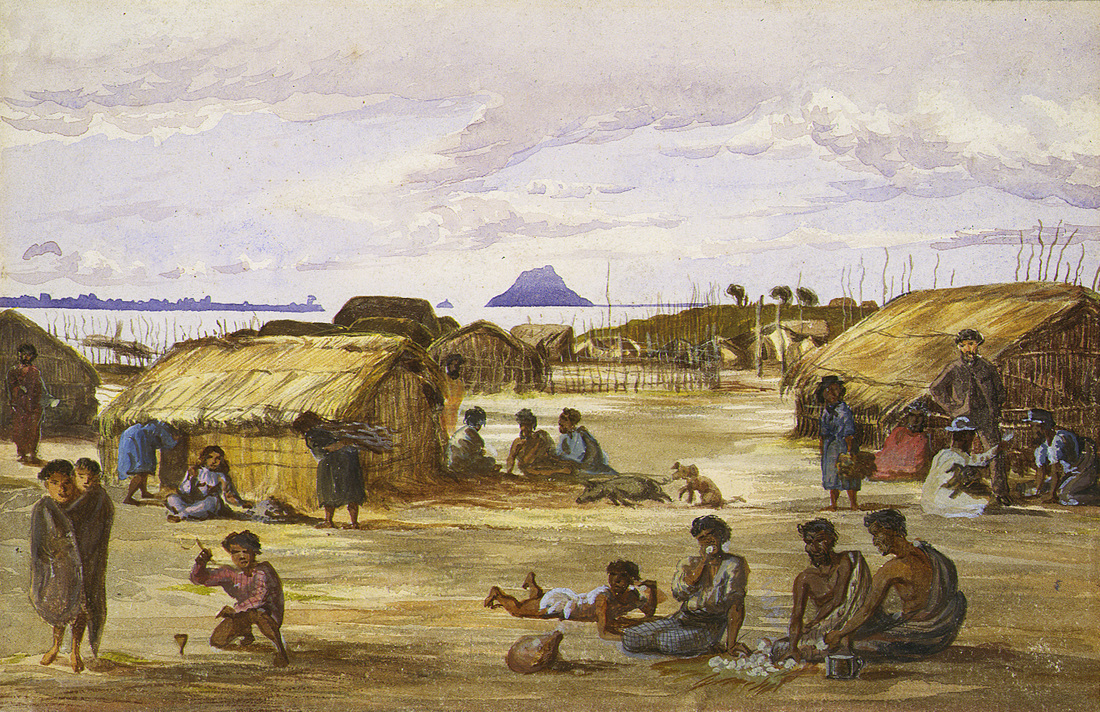
Robley, H.G., Enoka te Whanaki’s house at Matapihi, 1865, Museum of New Zealand Te Papa Tongarewa Collections Online, Registration number 1992-0035-833, http://collections.tepapa.govt.nz/Object/225016. Reproduced with permission.
During the 1840s and 1850s Maori Christian communities were large and active in many places around the country. This was the era when 'whare karakia' - Maori cathedrals such as those at Otaki - Rangiatea, and at Manutuke, on the East Coast were built. Henare Taratoa, baptised by the Bay of Islands-based Rev Henry Williams on a visit to Tauranga in the 1840s, was later a student at St John's College in Auckland where he was taught by Bishop George Selwyn.
Soldiers serving on the government side also brought bibles in their kit. Church parades, chaplains, and Christian services were part of army life. When Ensign Nicholl, brought up in the Church of England, was required to escort the Roman Catholic men in the 68th Regiment to service he noted it as a reluctant duty in his journal. When his red prayerbook was stolen from his digs at Otahuhu he was bereft.
Soldiers serving on the government side also brought bibles in their kit. Church parades, chaplains, and Christian services were part of army life. When Ensign Nicholl, brought up in the Church of England, was required to escort the Roman Catholic men in the 68th Regiment to service he noted it as a reluctant duty in his journal. When his red prayerbook was stolen from his digs at Otahuhu he was bereft.
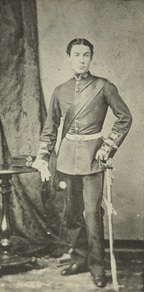
H. Gordon Robley (1840-1930), the creator of the image in this post, was a lieutenant in the 68th Regiment. While in New Zealand he made numerous sketches and drawings, and collected a good many objects. A great many of these now reside in research collections providing a frequent point of access to the history of Tauranga in the years 1864-5.
Robley, HG, Unknown, circa 1860, Purchased 1916, Museum of New Zealand Te Papa Tongarewa Collections Online, Registration number O.014620, http://collections.tepapa.govt.nz/Object/406471. Reproduced with permission.
Robley, HG, Unknown, circa 1860, Purchased 1916, Museum of New Zealand Te Papa Tongarewa Collections Online, Registration number O.014620, http://collections.tepapa.govt.nz/Object/406471. Reproduced with permission.
Jinty Rorke. 'Brown, Alfred Nesbit and Brown, Charlotte', from the Dictionary of New Zealand Biography. Te Ara - the Encyclopedia of New Zealand, updated 29-Aug-2013
Richard A. Sundt, Whare Karakia: Māori Church Building, Decoration and Ritual in Aotearoa New Zealand 1834-1863, Auckland: Auckland University Press, 2010
Richard A. Sundt, Whare Karakia: Māori Church Building, Decoration and Ritual in Aotearoa New Zealand 1834-1863, Auckland: Auckland University Press, 2010
 RSS Feed
