As the people of Tauranga Moana set down their challenge to the British commander in late March 1864, imperial troops were pressing south into Maniapoto territory in the Waikato. Over 1,000 British troops took on several hundred defenders at Orakau between 31 March and 2 April. It was here that Rewi Maniapoto's 'last stand' was staged. Surrounded, and short of water and food, the defiant call came out: 'E hoa, ka whawhai tonu ki a koe, ake, ake - Friend, we will fight you forever and ever!'
Who were the soldiers to whom these words were shouted?
Who were the soldiers to whom these words were shouted?
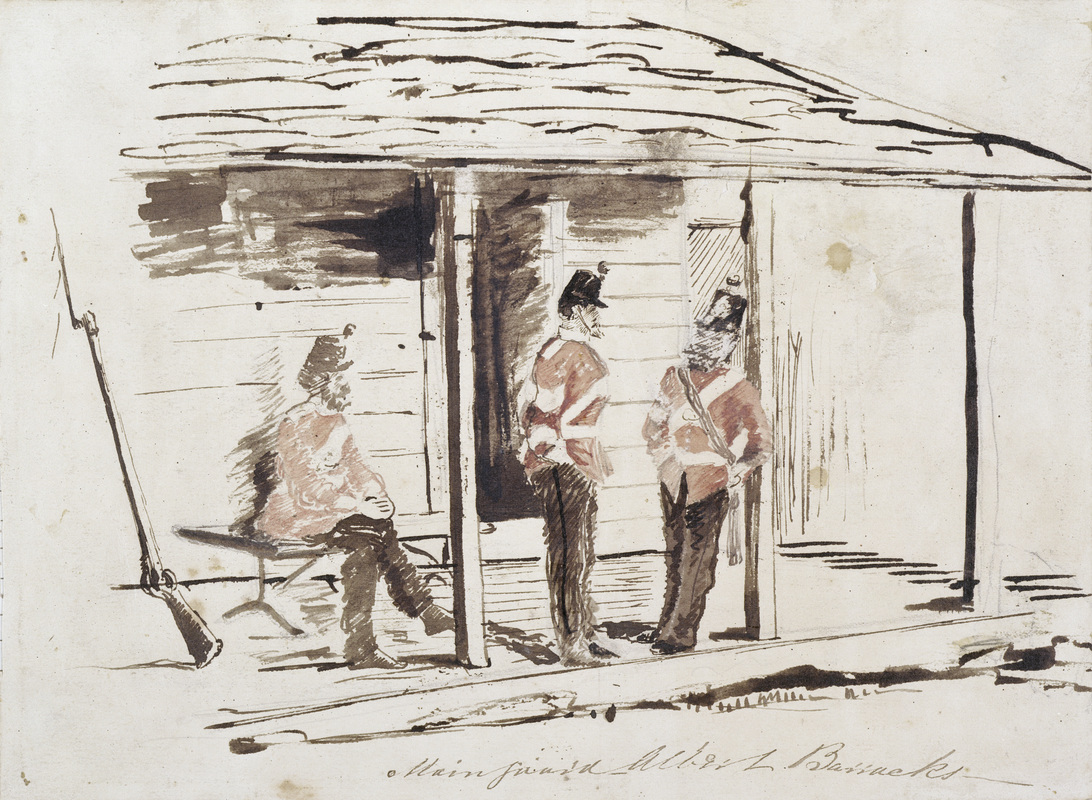
Thomas Matravers, Military guard at Albert Barracks, 1860s. 3-137-26a, Sir George Grey Special Collections, Auckland Libraries, reproduced with permission. Albert Barracks was New Zealand's largest military establishment occupying 23 acres between 1846-71. Part of the space is now occupied by Albert Park, Auckland.
Over 12,000 imperial troops, along with local militia, fought in the wars in New Zealand in the 1860s. Officers and men in British regiments came to New Zealand from England, India, Australia and further afield. British redcoats (soldiers) and bluejackets (sailors) were a common sight in ports across the mid-Victorian world. Some of those who served in New Zealand ended up staying in the colony - some as settlers on land confiscated in the wake of fighting; some marrying Maori women and establishing families. For the majority, however, service in New Zealand was but one episode in a career where army or navy orders dictated a variety of destinations.
Officers and men of the 43rd and 68th regiments, and of the 1st Waikato Militia were posted to Tauranga.
We know more about some of these men, from records they kept, and records kept about them.
Officers and men of the 43rd and 68th regiments, and of the 1st Waikato Militia were posted to Tauranga.
We know more about some of these men, from records they kept, and records kept about them.
| Ensign Spencer Nicholl (1841-1908), arrived in Auckland on 4 March 1864. Twenty-three years old, Nicholl was a junior officer with the 43rd Regiment. His first impression of Auckland from the deck of the Silver Eagle was of a town that was 'very pretty' and 'very stragly' (p.148). After three months at sea, he was keen to get ashore. Nicholl came to New Zealand from England where he had been three years in the army, living at Chatham Barracks. The youngest in a family of nine, the army was a common destination for the younger sons of middling and upper class families. As Nicholl and the rest of the company from the Silver Eagle disembarked the band of the 68th Regiment played. In the journal he wrote on the night of 4 March 1864 Nicholl recorded coming ashore and setting off for the Albert Barracks: 'they played a little on the pier before we started. It is about a mile from the pier to the camp the latter is on the top of a hill overlooking the town, the road is very steep the whole way up. The camp is surrounded with a stone wall.' On the way up the hill he saw Maori for the first time. 'There are very few of them tattoed and mostly of these are women.' (p.148) After seeing the men to their huts Nicholl 'had a glass of beer for which I was very thankful' (p.148). The next day Nicholl and the rest of the new arrivals were 'all served out with a blue serge jumper and a blanket, officers and men alike.' (p.151) They were to spend the next few weeks in the Waikato before being posted to Tauranga in April. Diary of Ensign Spencer Perceval Talbot Nicholl (1841-1908). MS-1712, Alexander Turnbull Library, National Library of New Zealand, Wellington. | James Bodell (1831-1892), of the 1st Waikato Militia, arrived in Auckland from Melbourne in September 1863. Bodell's first impressions of Auckland were less favourable than Nicholl's. To him it appeared 'a poor dirty sludgy Place.' (p.131) Born in Nottinghamshire, Bodell enlisted in the 59th (Nottinghamshire) Regiment at the age of 17. He served in Ireland and Hong Kong, becoming a sergeant. In 1854 he purchased his discharge and spent the next nine years making, and losing, fortunes in Van Dieman's Land and on the Victorian goldfields. Walking the Melbourne streets with no money and uncertain fortunes, 'soldiering' became an option again in late 1863. 'Posters were posted all about Melbourne requiring Volunteers for New Zealand. My old soldiering propensities revived, and my Friend and myself put our names down for New Zealand. I would have gone to any Part of the World to get out of Victoria. In a few days about 200 was enrolled and in a Week about 400 and 500 was mustered, and signed the declaration.' (p.125) Disembarking in Auckland on 13 September 1863 Bodell recorded: 'We went straight up to the Barracks. Here we stopped about one hour to get refreshments at the Canteen, and we indulged rather freely, before proceeding to our first Station Otahuhu. We formed advance Guard. This I had charge of and as I was a Stranger to Otahuhu I took a man (a [Military] Pensioner) who had only been out of Auckland about six Months, to show me the way to Otahuhu Barracks. We marched on, and this old Scoundrel took me and the advance Guard straight to Rogers Criterion Hotel Otahuhu passing the turn to the barracks about half a Mile. Directly I found I had passed the Barracks about half a Mile.... I turned my men to the right about and went into the Camp, about half an hour after the headquarters. I was told off to a hut with 20 men and a Corporal. Each of us was marched to the Canteen and received one Pint of Ale. This was my first interview with Captain Hunter our future adjutant. Next day we were served with our Regimentals and in two days from landing we were soldiering in earnest.' (pp.131-2) Bodell was to have a colourful period of service in New Zealand before resuming civilian life. By the 1880s he was the mayor of Tauranga and an advocate of temperance. Keith Sinclair, ed, A Soldier's View of Empire: The Reminiscences of James Bodell 1831-92, London: Bodley Head, 1982 Keith Sinclair. 'Bodell, James', from the Dictionary of New Zealand Biography. Te Ara - the Encyclopedia of New Zealand, updated 30-Oct-2012 |
Join HistoryatVic on twitter to get regular updates from Looking Down the Barrel of History.
 RSS Feed